
New story in Health from Time: ‘I’m Terrified.’ Inside a Hospital Preparing for Italy to Reopen


Enrico Clini has been running hospitals for almost 20 years. As the head of the pulmonary department in the Policlinico hospital in the Italian city of Modena, thinking ahead is what he does best. But as Italy and other European countries take the first cautious steps out of lockdown, Clini and other Italian doctors are now thinking of how to prepare for the second phase of the coronavirus outbreak: living with the virus. “No ones knows what the next year will look like,” says Clini. “I’m thinking in terms of weeks, not years.”

As in other overwhelmed towns and cities across the northern Italian region of Emilia Romagna, Modena officials have spent the last few weeks focused on logistics. At the peak of the crisis, Clini walked the 2 miles from his home to the hospital each day through the empty cobblestones streets of Modena, constantly running numbers through his head: the number of ICU beds, how much personal protective equipment is available, how many nurses are out sick.

Keep up to date on the growing threat to global health by signing up for our daily coronavirus newsletter.

This week, he woke to a new, more optimistic number: in the last 15 days, his hospital has seen a 30% decrease in COVID-19 patients. For the first time since the beginning of the outbreak, the region of Emilia Romagna has seen more people recover than getting tested positive, according to the Italian newspaper la Repubblica.

But as a limited number of shops and businesses have been allowed to reopen in some regions of Italy, including bookstores and children’s stores, doctors and nurses are already preparing for a second wave of cases.
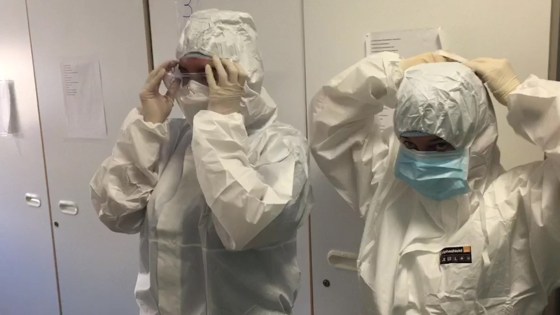
italy-doctors-country-reopening
Courtesy of Enrico Clini, Policlinico HospitalAnnalisa De Santis and Beatrice D’Annibale (right), two nurses at Policlinico hospital in Modena, get ready for a morning shit on the COVID-19 ward.

“I’m terrified of the country reopening,” says Roberto Tonelli, a pulmonologist who has spent the last 6 weeks away from his 2-year-old daughter. “I understand the economy needs to restart, but I already see parks and streets full of people, and I can’t help but worry.”

As European countries are slowly thinking of how to reopen, hospitals are thinking of how to adapt. “In recent weeks, all our usual patients disappeared overnight,” Tonelli says. “Now we have to start thinking of how to handle non-COVID and COVID patients alike.”

Since the end of February, the Modena Policlinico hospitals has seen 1,240 COVID patients, an extraordinary number for a pulmonology ward usually staffed by 25 doctors and 13 nurses. It shifted its entire focus on responding to the coronavirus outbreak. “We’ll have to return to how things were, the problem is that we don’t know if we’re at the right time to go back,” Clini says.

Valentino Capone, a 27-year-old nurse who has been working 12-16 hour shifts to respond to the emergency, is worried of what that will mean for the hospital staff. “When the number of casualties won’t make the front pages of newspapers, the working situation in hospitals will be the same. Masks, washing hands, protective equipment is our new normal.”

Please send tips, leads, and stories from the front lines to virus@time.com

Popular posts from this blog

New story in Health from Time: COVID-19 Has Been ‘Apocalyptic’ for Public Transit. Will Congress Offer More Help?

While trying to get to work over the past few months, Brittany Williams, a Seattle home care worker, has often been passed by two or three buses before one stops to let her board. Buses in her area that once carried anywhere from about 50 to 100 passengers have been limited to between 12 and 18 to prevent overcrowding in response to coronavirus, and Williams’ commute, typically a half-hour ride, now takes more than double that time. Other Seattle transit riders have described budgeting as much as an extra hour per trip to account for the reduced capacity, eating into their time at work, school or with family. Even with the ridership limits in place, Williams, 34, doesn’t feel safe on public transit. Some passengers don’t wear face coverings, and bus drivers sometimes ignore capacity limits, she says. On one ride with her seven-year-old son, she decided to get off at a stop far from her home after a driver allowed a crowd of people to board. “It’s very trying. I’ll put...

New video by blogilates on YouTube

Day 8 - 14 | Blogilates 2020 Challenge You guys are CRUSHING the #2020Challenge so far! Idk about you but my abs are soooooore! This week, we're doing 20 reps of abs every day + 20 reps of another new exercise every day! If you need a little extra motivation, text my number (510-692-4556) and tell me all about it so we can come up with a solution together! This link also works: https://ift.tt/2Qjqw7G This week's moves are: Jan. 8th (starts 0:48) - 20 butterfly bridges + 20 criss cross (butt + abs) Jan. 9th (starts 2:43) - 20 oil riggers + 20 rollovers (arms + abs) Jan. 10th (starts 8:29) - 20 lunges + 20 leg outs (legs + abs) Jan. 11th (starts 11:03) - 20 walnut crushers + 20 single leg drops (back + abs) Jan. 12th (starts 13:41) - 20 sprinters + 20 crunches (obliques + abs) Jan. 13th (starts 16:27) - 20 squat jumps + 20 russian twists (cardio + abs) Jan. 14th (starts 18:57) - 20 plank jacks + 20 butt ups (total body + abs) Here is where I get all of my music! Epidemic Sound: ...

New story in Health from Time: Why You Should Add Rest to Your Workout Routine

Most fitness advice urges people to squeeze in more workouts. That’s reasonable, considering government data show that only about a quarter of American adults meet the current guidelines for adequate physical activity : 150 minutes of moderate or 75 minutes of vigorous aerobic activity per week, plus two bouts of muscle-strengthening exercise. Meeting these guidelines is important, since getting enough exercise can improve an individual’s physical and mental health . But when it comes to exercise, it is possible to have too much of a good thing . In fact, research suggests taking strategic time off from your workout routine can maximize the benefits of physical activity, and minimize the risks. “Rest and recovery absolutely are necessary,” says Hunter Paris, an associate professor of sports medicine at Pepperdine University in California. “Fatigue, to a degree, is beneficial [because it signifies progress]. But there comes a point where fatigue can accumulate and ove...